



Task Force on Climate-Related Financial Disclosures (TCFD)
Read Chapter Report Contents
Governance
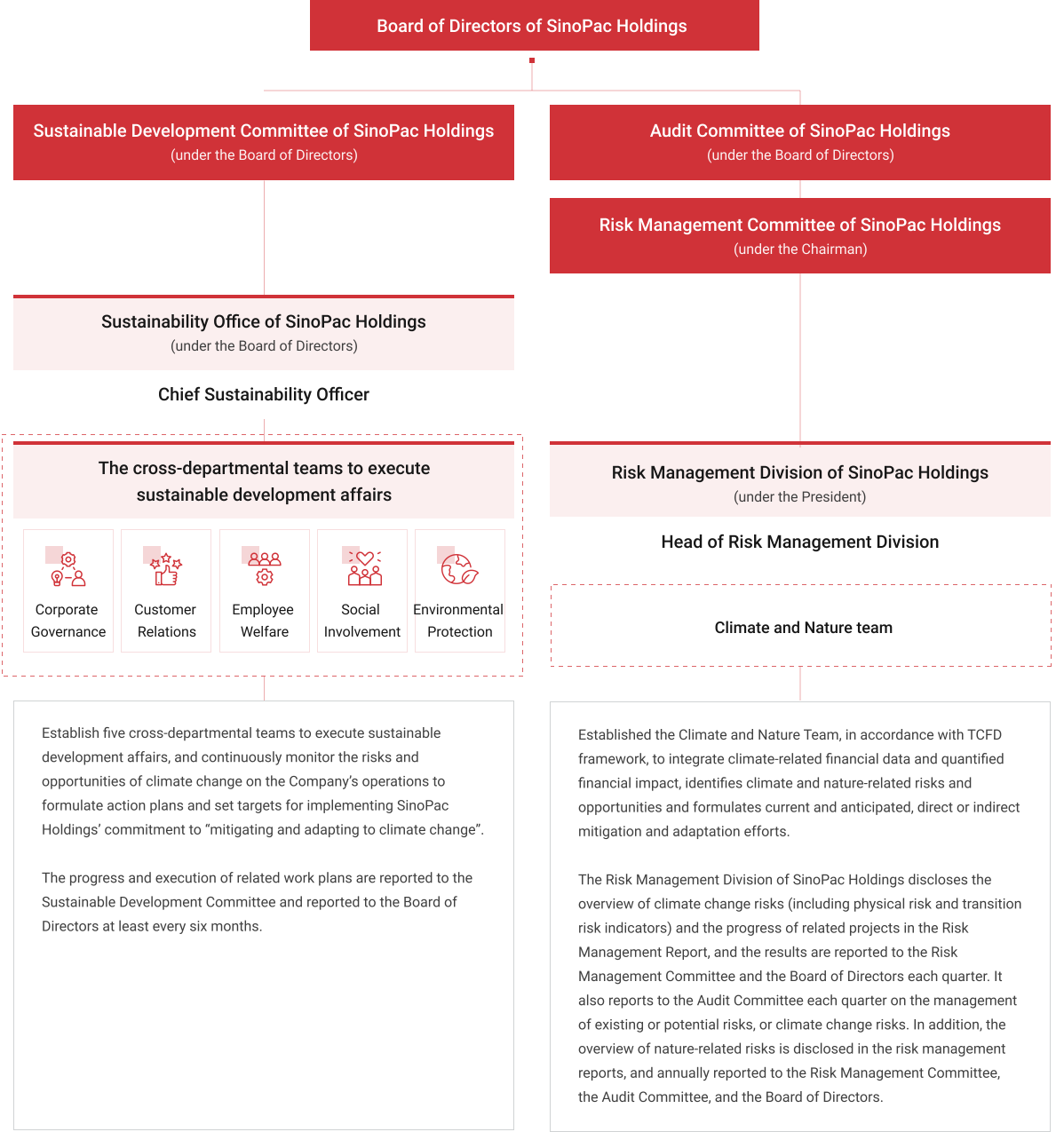
The Board of Directors serves as the highest governing body for climate and nature-related issues and bears ultimate oversight and management responsibility for such matters. The "Sustainable Development Committee" has been established under the Board of Directors, alongside the "Sustainability Office" as a dedicated unit responsible for implementing sustainability-related tasks. The "Risk Management Committee" has been established under the governance of the Chairman. The Committee is chaired by the Chairman and comprises external members, the President of SinoPac Holdings, and the Chairman of Bank SinoPac. These committees jointly oversee and manage key matters, including sustainability management, and climate and nature-related strategies implementation, as well as associated risks and opportunities.
To further enhance the management of sustainable development, starting from July 1, 2024, our Company has elevated the Sustainable Development Committee to a functional committee of the Board of Directors. The members of the Sustainable Development Committee consist of the directors from SinoPac Holdings and its subsidiaries, with a minimum of three members, including at least 1 independent director of the Company. Currently the Sustainable Development Committee comprises a total of 11 directors from SinoPac Holdings and its subsidiaries, including the banking, securities, and leasing businesses, to ensure alignment and effective implementation of sustainability strategies across the Group. The Committee also includes 3 independent directors of SinoPac Holdings, and the Chairman of the Company serves as the convener and chair of the Committee. In the meanwhile, the Company has also established a Sustainability Office under the Board of Directors, serving as a dedicated unit for sustainable development. The Sustainability Office encompasses five cross-departmental teams responsible for the implementation of sustainability-related tasks. The progress and execution of related work plans are reported to the Sustainable Development Committee and reported to the Board of Directors at least every six months.
The Company established the "Risk Management Committee" under the governance of the Chairman. The Committee is chaired by the Chairman and comprises external members, the President of SinoPac Holdings, and the Chairman of Bank SinoPac and is responsible for managing climate- and nature-related risks to strengthen climate- and nature-related resilience. To improve the management mechanisms of climate and nature-related risks and opportunities, SinoPac Holdings has incorporated climate change risks into the “Risk Management Policy”. In addition, the Company revised the “Guidelines for the Management of Climate-Related Risks and Opportunities” in accordance with the core requirements of the IFRS S2 Climate-related Disclosures and the latest recommendations of the Taskforce on Nature-related Financial Disclosures (TNFD), and renamed it as the “Guidelines for the Management of Climate and Nature-Related Risks and Opportunities”, which came into effect in March 2026 to enhance alignment with international practices.

The Risk Management Division serves as the coordinating unit for overall climate and nature risk management. It discloses the overview of climate change risks (including physical risk and transition risk indicators) and the progress of related projects each quarter in the risk management report, and the results are reported to the Risk Management Committee and the Board of Directors. It also reports to the Audit Committee each quarter on the management of the Company’s existing and potential risks, or climate change risks. In addition, the Risk Management Division discloses the overview of nature-related risks annually in risk management reports submitted to the Risk Management Committee, the Audit Committee, and the Board of Directors.
To advance climate- and nature-related strategies, the Risk Management Committee established the "Climate and Nature Team." The Risk Management Division serves as the coordinating unit, integrates climate-related financial data and quantified financial impact, identifies climate and nature-related risks and opportunities and formulates current and anticipated, direct or indirect mitigation and adaptation efforts.
SinoPac Holdings Climate Governance Structure
The Climate and Nature Team adheres to the four major TCFD aspects (governance, strategy, risk management, and metrics and targets) in disclosing climate information, and adheres to the TNFD (Taskforce on Nature-Related Financial Disclosures) framework and LEAP (Locate, Evaluate, Assess and Prepare) analysis methodology in managing climate and nature-related information. The 6 main tasks of the team are shown in the table below:
| Main tasks of Climate and Nature Team | Instruction |
|---|---|
| 【Climate-related Risks and Opportunities】 Identification, Scenario Analysis, and Financial Impacts |
|
| 【Climate Strategy Actions】Establishing corresponding operational strategies, financial plans, and mitigation and adaptation measures for climate resilience |
|
| 【Formulating nature-related risk management measures and strategies】 |
|
| 【Policy Framework and Management of Operational Risks】 |
|
| Formulating climate indicators and targets |
|
| Compiling climate and nature-related financial disclosure reports |
|