

Identification of Material Topics
Identification and Disclosure of Material Topics
Materiality analysis is an integral part of SinoPac Holdings' sustainability strategy, target-setting and tracking, and overall corporate risk management. SinoPac Holdings continuously follows and gains insights from international sustainability trends, global sustainability ratings and sustainability disclosure standards. The company also references the material issues identified by international industry benchmark peers and domestic counterparts, and conducts annually materiality assessments in accordance with the guidance and spirit of "GRI 3: Materiality Topics” and the principle of double materiality. In 2025, SinoPac Holdings continued to review and confirm the list of sustainability issues and positive and negative impacts defined in the previous year, considering market trends and due diligence results. The company conducted an internal and external stakeholder impact survey covering 7 stakeholder groups including employees, customers, shareholders (investors), media, communities/non-profit organizations (NPOs)/non-government organizations (NGOs), competent authorities, and suppliers. It sought to understand internal and external stakeholders’ assessment results of the impact on the external environment, economy, and people in order to adjust the ranking of positive and negative impacts and material topics. In 2025, SinoPac Holdings collected a total of 1,156 questionnaires on impact to internal and external stakeholders, and used the results of the survey and internal due diligence (including internal and external complaint channels and external media news analysis) to adjust the materiality level of positive and negative impacts and compile the impact matrix. SinoPac Holdings identified 19 material topics, which were the same as the previous year. 8 were critical topics, 10 were important topics, and the other 1 were basic topics. SinoPac Holdings also identifies double materiality topics with significant impact on external parties and the operation of the Company through surveys conducted with senior executives, in accordance with the double materiality principle. Meanwhile, corresponding management, strategies, or action plans are formulated or adjusted to mitigate the impact of related risks.
For more information, please refer to the chapter "Identification of Stakeholders and Material Topics" in our Sustainability Report.
Identification of Material Topics
- Critical topics: Topics with high level of impact on the economy, environment, and people and high likelihood of occurrence. Provide full explanation in the Sustainability Report in accordance with related GRI Standards and disclose detailed management and performance of the topics in.
- Important topics: Topics with medium level of impact on the economy, environment, and people and medium likelihood of occurrence. Provide full explanation in the Sustainability Report according to GRI Standards and disclose key management and performance of the topics.
- Basic topics: Topics with low level of impact on the economy, environment, and people and low likelihood of occurrence. Most of them are routine issue to be considered as the basic management topic. Only necessary follow-ups are disclosed in the Sustainability Report.
Explanation of Changes in Material Topics in 2025
There were slight changes to the material topics in 2025 compared to the previous year. SinoPac Holdings identified 19 material topics, which were the same as the previous year. 8 were critical topics, 10 were important topics, and the other 1 were basic topics.
Among them, the material topics that experienced changes include “Accessibility of Financial Products and Services”. Considering the Group’s business expansion and based on stakeholder feedback, its level of importance was upgraded from “basic” to “important.” Another topic is “Climate Change and Net Zero Strategy.” As Scope 1 and Scope 2 emissions are relatively low in the financial industry and financed emissions constitute the primary source, the focus of net zero strategies lies in investment and lending portfolios. Given that this topic is already covered under “Sustainable Finance,” and based on stakeholder feedback, its importance was downgraded from “critical” to “important.”
Double Materiality Analysis
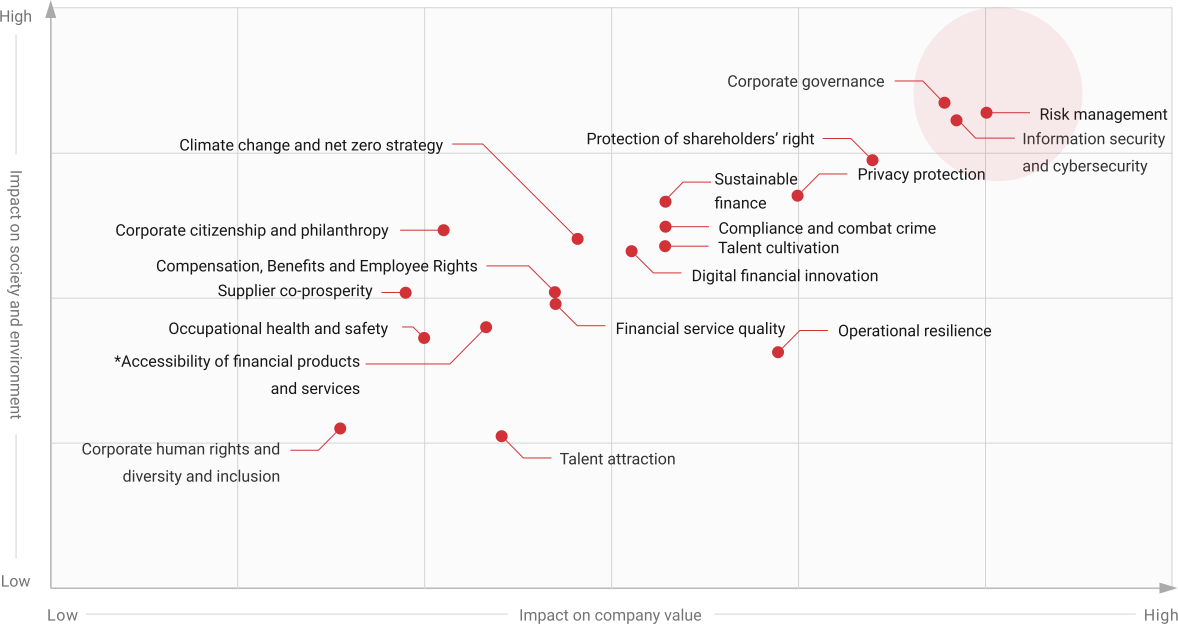
In addition to considering the impact of material topics on the external economy, environment, and people, SinoPac Holdings also adopted the double materiality analysis in 2023 to understand the potential financial impact of related risks on the Company, to develop the Company's business management strategies, and allocate resources effectively. SinoPac Holdings' executives and senior managers rate the financial materiality of the aforementioned materiality topics on the Company's costs, revenue, reputation, and risks. Then the external impact level was incorporated to identify the double materiality topics that have significant impact on both internal and external entities and create the double materiality matrix.
There were no significant changes to the material topics in 2025 compared to the previous year. The top three double material topics were risk management, Information security and cybersecurity, and corporate governance.
2025 SinoPac Holdings' Double Materiality Matrix